Monday, July 27, 2009

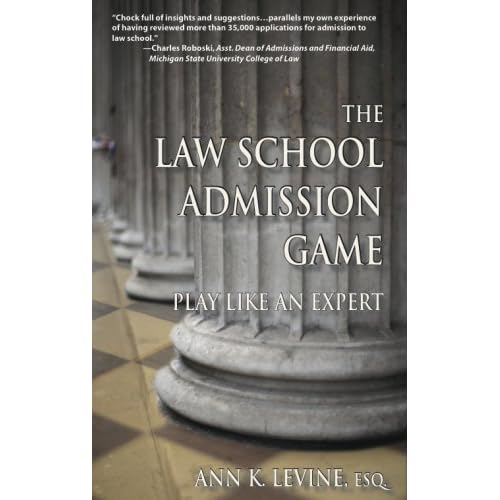
The Law School Admissions Game: Play Like an Expert

Getting into law school is in many ways more complicated than law school itself. By the time you reach law school, you have been in school for at least 16 years, probably more. The application process, however, is a once in a lifetime experience, and different even from the college process. In school, professors are giving you assignments and deadlines, administrators are always giving you direction on what form to complete next and how to fill it out correctly, and if nothing else, your fellow students are there to push you in the right direction. When applying, however, you are on your own. Furthermore, the information available is usually 1) flat out wrong 2) really just there to sell you another product (LSAT prep sites) or 3) well meaning but derived from secondhand experience.


None of that matters anymore, as with her brand new book, The Law School Admission Game: Play Like an Expert, Ann Levine has created the single most useful resource for law school applicants on the market today. In 160 pages, she is able to provide a roadmap to the application process, insider information on how your application is evaluated, and a dose of reality to keep you grounded but moving forward.

Why is this book so helpful? It begins at the 'twinkle in your eye' stage with important questions to consider regarding law school and the application process. It is here that this book separates itself from the the rest of the admissions support already available by accepting that people apply to law school for a variety of reasons, from a desire to serve others all the way to a desire to be in a respected field. An early chapter also takes time to give consideration to how different majors look on an application. I thought this was highly insightful, as most other resources assume you were a Pre-Law or History major, but Ms. Levine shows how to make your Art History (or in my case, Psychology) major work for you. There is also information for applicants with career experience between college and law school.

The Law School Admission Game then moves onto LSAT and GPA information, as well as a thoughtful explanation of the rolling admissions process. It should be noted that this book is not LSAT prep in any way, but there is full, detailed information on how LSAT scores reflect on your application. Also, this book is able to offer advice on retaking the LSAT and score cancellation. Although I only took the LSAT once, this is the most comprehensive source for information on LSAT cancellations and retakes. There are a number of scenarios provided as examples, covering almost any situation.

From there, you move into the meat of the application. The Letters of Recommendation (LORs), the Personal Statement, and optional essays. Ms. Levine takes the guesswork out of the LORs. The LSAC does a terrible job explaining how they work, but this book is able to clarify everything in a few pages. Also, there is finally sound advice on how to choose recommenders. Other sources simply say focus on professors, and while Ms. Levine agrees, other options are explored as well. For the personal statement, there are no useless sample essays, but instead start to finish advice on picking a topic that suits you, and that will make an impression on admissions staff. How do you know it will make an impression? The author relates several personal experiences as an admissions director reviewing actual personal statements.

From there, you are provided with information on what to do after you have mailed in your application, including some advice on how to professionally communicate with admissions offices. I can pretty much sum it up in three words: Use Professional Communication.

Finally, The Law School Admission Game addresses other concerns, such as transfers and scholarships. These sections are less detailed, as frequently Ms. Levine points out that it varies too much from year to year and school to school for broad statements. That said, the section on deciding which school to attend is an honest, thoughtful look at the options of different law schools.

The discussion of deciding where to attend is one of the reasons I found this book so groundbreaking. Ms. Levine is able to encompass such a large and unwiedly topic and compress it down to easy to understand terms, without sacrificing fidelity. The benefits of applying to a top 30 law school are discussed, and this book definitely will help you apply to the best law schools in the country. And yet, regional (Tier 4) law schools are also given equal weight, as their value is discussed in the local job network, or those with career or family obligations. Never have I read advice from someone so able to understand the value in both, as well as everything in between.

Ms. Levine also has an uncanny ability to use language in a way that is more in line with high school teacher than lawyer. Clear, direct, and concise, the book is eminently readable. Additionally, the language is modern and, dare I say, hip. I have blogged previously (here) about Ms. Levine's ability to communicate with law school applicants in a supportive and personal way. Amazingly, it shows through in this book as well. She is frank, including advice to 'stop bitching;' and admonishing that you are not the exception for trite essay topics, despite what you may think. This book reads easily, and moves quickly, while providing plenty of information.

As I mentioned before, The Law School Admission Game is full of firsthand experience Ms. Levine gained working as a director of admissions. She is able to give real insight into how personal statements, low LSAT scores, bad resumes, or LORs are actually used by admissions offices. This is phenomenal information, and comes with full credibility. Also, Ms. Levine is current in this admission market, acting as a private admissions consultant. Having said that, she never once uses this book to sell her services with a cheap, "for the rest of the information pay for my services" hook that is so common in media today.

If I had to pick out any shortcomings, it would be that a few sections are only discussed from one side. For example, the virtues of applying early in the rolling admissions timeline are discussed, but there is little advice on how to approach applying later in the cycle. I think the biggest reason I noticed this is because the rest of the book is so balanced and comprehensive.

All in all, if you are in the process of applying to law school, getting ready to apply soon, or even just thinking about applying, this book is a great read that will answer nearly all of your questions. i cannot recommend it highly enough. As a regular reader might know, I am a do it yourself kind of guy. The Law School Admission Game gives you the information to make informed decisions and work the admission process to get into your ideal law school.

Buy this resource on Amazon here
or
Barnes and Noble here

Saturday, July 11, 2009

Ten Questions for Law Students

I finally got my schedule for the upcoming semester! Even though we have been warned repeatedly that 'nothing is final until August 7' (a few days before classes start), I can't help but look ahead to the coming semester.

I do have a few questions for those of you who have already experienced your first year of law school, and therefore created the easiest test you will ever take relating to law school:

Question 1: I only am scheduled for about 10-15 hours of class, as of now. I am wondering how accurate this is. I have heard that I can expect additional time spent in mandatory small group discussions and TA reviews. About how much of your time is scheduled by your school throughout the week? (My guess is that it doesn't matter, you are at the school about 40 hours per week regardless.)

Question 2: Additionally, in college I was told to expect about 2 hours of work outside of class for each hour spent at class. Therefore 15 credit hours per week was assumed to have about 30 hours of work per week outside of class. Is there a commonly accepted ratio for law school? (I am thinking it has got to be worse than undergrad.)

Question 3: And as a follow up, I found that I spent about 10 hours per week outside of class doing school work, the rest of the time I spent socializing, playing sports, Halo and Smash Bros, or doing volunteer and extra curricula. Plus I was employed all through college. How much free time can I expect? (My guess: Sports? Socializing? Halo? Ha! Try reading, writing, and studying.)

Question 4: I have been told law school is uber competitive and there is no such thing as a study group since no one wants to help anyone get ahead. Is this true?

Question 5: Do professors really call on you at random all the time, or just on days when they don't have a full lecture planned?

Question 6: My college roommate is now in medical school, and he reports that he is almost encouraged NOT to go to class but to instead download the notes and audio recording. Is this the case in law school?

Question 7: My other college roommate told me, "Law school is no different than college except you have to read every night." Fair assumption?

Question 8: Take notes via laptop or pen and paper? (I'm leaning heavily towards pen and paper, besides, how do you not get distracted by Twitter/Facebook/Instant Messanger?)

Question 9: At every open house or accepted student's day I attended, or every blog I read by law students or admissions experts, incoming students always ask "What can I do to prepare?" and current students or experts always say, "Relax, enjoy life, spend time with friends and family, do fun reading, see a movie, sleep." Anyone else want to add an opinion? (This is going to be the topic of my next post as well, I'll include your answers.)

Question 10: I am not sure what kind of law I would like to practice, or how I will ultimately use my law degree. Is this going to put me behind? Should I pick something that sounds good and go for it, or should I just wait and see if anything catches my eye? (I ask because I know that pretty much as soon as I start school I also need to be thinking about a summer job or internship, and start defining my career.)

BONUS QUESTION: What is the one thing you wish you knew before you started your first year? (WRITE ANYTHING AND I WILL GIVE YOU CREDIT. Except for 'Wear Sunscreen', that is overused and unoriginal, without being a classic.

Leave me answers in the comments and I will share them later!

Friday, June 26, 2009

Comment Response

I am going to try to periodically respond to comments left on this blog. I have not done so yet because I do not receive them very frequently, but I want to continue to do this monthly or bimonthly.

Comment 1:
Bella Vita said...
"Congratulations Bro, that's got to be an incredible feeling!" in response to my post Greatest Feeling in the World.


Thanks man, it is! Keep me posted on your achievements too.

Comment 2:
Aaron said...
"Hey Spencer - thanks for following. I recommend @accesstojustice and @kbladow as well. Very frequent updates and great info. Are you @jd2b?" in response to my post Who I Follow on Twitter.


Thanks for the recommendations, I have followed both and I am encouraging all my readers to do the same.

I am NOT @jd2b! I have also discovered that there is a JD2B website, which I am also not a part of!

My Twitter is @Spencerm1. I will offer that I am not a Pro User of Twitter! I update about once a day, sometimes less. It is primarily a personal account as well. I do post about fun things I have recently done, my job, the last song I beat on Guitar Hero (so in August none of these will happen anymore). I also write about the books I have been reading and share good internet links.

Well, there you have it, my first two comments, responded to. Cheers guys!

Wednesday, June 24, 2009

Auto-Tune the News

Breaking news. The fifth Auto-Tune the News is up.

Tuesday, June 23, 2009

The Choice - Part 3 "Why UB?"

(The Choice is an ongoing section where I will be examining my decision to attend the University of Baltimore.)

I have meandered around slightly on this topic, and I feel it is time for me to actually talk about what drew me to the University of Baltimore.

I initially applied due to the location. I have lived in Baltimore for the past 6 years, and absolutely adore the city. I am well established here, and besides, the only two law schools in Maryland are within a mile of each other right in Baltimore City.

Secondly, I had heard great things about the school. Everyone I talked to about it knew someone who was either in the program or had completed the program, and all they could say is "He/She loved it!"

Additionally, according to my LSAT/UGPA numbers, it was a school that I was highly likely to be accepted to.

Once my acceptances came around, I had a few options. The University of Baltimore was, by far, the most affordable. Public school tuition at in-state rates, combined with the highly affordable housing options made Baltimore the financial no-brainer. My Twitter contacts (click here) agree.

I also attended the accepted students day, and when Dean Closius spoke, I was further encouraged. He addressed head on the school's short comings and took any question from students or parents attending.

Still, I think the final decision came down to two things: The Location and The Price. I really liked the University of Miami, but the housing discussed by current students and the school ran at least double the price of my current apartment. I also considered Hofstra, but even with a large scholarship the tuition was rather high. Drexel appealed to me, but I was a bit put off by the accreditation situation, and again, even with a large scholarship it was more expensive. Finally, Baltimore is home to my current social network, my past professional network (including mental health, social work, restaurant and security fields) and my small but hopefully burgeoning legal network.

Now, having made my choice, I am highly satisfied and cannot wait for school to start!

For all you current (or former) students, how did you decide which school to attend?

Wednesday, June 17, 2009

Auto-Tune the News

Hello all.

This post will be almost strictly fun.

Since there is such a strong connection between law and politics, I thought that this would be a relevant topic.

These videos are posted on a YouTube account belonging to Michael Gregory. Michael Gregory is a pretty interesting person, one of those people who is not only amazingly musically talented, but also has the humor and presence of mind to use it in new and interesting ways. Search YouTube and you will find him performing Acapella raps at open mic night, auditioning for American Idol, and using his Auto-Tuner on the news.

These videos are many things. First of all, they are hilarious. Secondly, they are pure genius. The writing combines random humor with a nice caricature of mainstream hip hop, some biting news commentary, and the occasional highly subtle, but deftly crafted, satire. The production values are extremely high, which makes the fuzzy green screen cutouts a sort of self-aware joke. I could go on and on, but that is not the focus of this blog. Instead, enjoy a nice study break, on me.


For more, I recommend checking out Michael Gregory's YouTube account here, as well as each of the individual video pages. The descriptions contain the lyrics, information about the cast of characters, and other tidbits. Click here for a playlist of all in order.

Saturday, June 13, 2009

Law School Social

One of my first official law school experiences was a baseball game and happy hour this weekend. Our law school was able to secure two free tickets for every incoming student at the Orioles game against the Braves. Awesome, right? Also, prior to the game there was a happy hour at a nearby bar for some drinks and food.

I was a little nervous about attending this event, knowing no one, but luckily all first year students also received those awesome Baltimore Law shirts, so I was hoping we would all be wearing one.

I got held up at work, but did get to some of the happy hour. I was clearly in the minority of those who decided to actually wear their shirts, but it was a great event to meet some of my soon to be classmates.

One thing I did discover is that everyone has a different expectation of their first year. Some are already in a panic about the amount of work. Some are already working on "Before You Start Law School" textbooks and courses. Some are concerned about how often they will be able to go out during the week.

I was also surprised by the varying age range and experience levels of those attending. Many were right out of college, quite a few had some full time work experience, and there were a few older students. I think I am in the minority of students who did not work at a law firm prior to enrollment. I am hopeful that this will not be a setback. Personally, I think my work experience has actually prepared me more for law school than anything else I have done up to this point.

Although the game did not go well (O's lost, pretty badly), a free ticket is something I will never turn down. I also enjoyed the chance to meet some of my future classmates. Finally, if nothing else, I am now really excited to start school soon.